
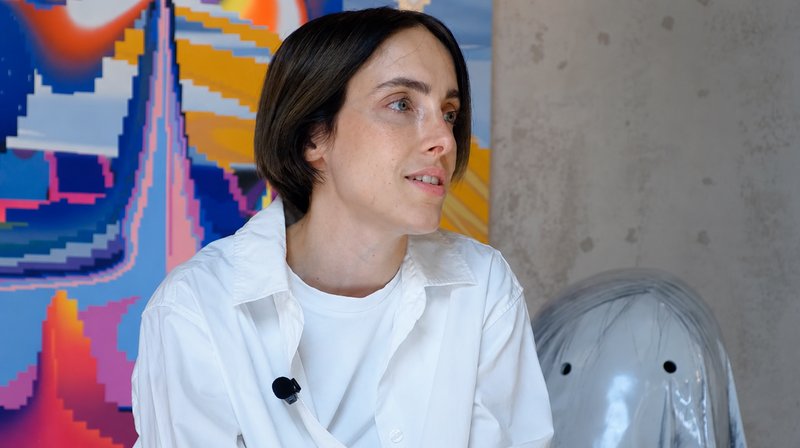
Interview-In Conversation with Rana Dehghan About Her Douet Show in Dastan: Outside - Focus Room 3
- This exhibition revisits a dialogue that first emerged between your work and Yousha Bashir’s at Liste Art Fair Basel in 2023. How has your relationship with these ghost-like sculptures changed since they were first exhibited?
It’s been almost four years since that exhibition, and the more I think about it, the more I feel that my relationship with them hasn’t really changed. Maybe they’ve simply settled more deeply for me, they’ve aged a little and become more established. But their position, their nature, and the feeling they carry are still the same for me as they were four years ago.
- You’ve previously said that these figures are closely connected to your inner self and psyche. Do you see them as a kind of self-portrait, as psychological states, or as independent characters?
Well, they are both self-portraits and something that comes from my psyche. These spirits took shape during my psychoanalysis sessions, so in that sense they are self-portraits, they involve my psyche and are about my inner world and my thoughts. At first, we actually called them Jaan [“soul” or “life”], because to me these spirits are alive. You describe them as ghost-like, which can make them sound as though they have no real substance or being, but to me they have a life of their own. They are alive, and they are doing different things.
- Fiberglass transforms the appearance of a soft, light, almost weightless sheet into something rigid and permanent. How important is this contrast between visual softness and physical hardness to the work?
When I first started making these sculptures, I wasn’t thinking that much about the material itself. What mattered more to me was that they had the appearance of fabric and evoked that classic image of a ghost that we all recognize from childhood. I experimented with different materials. I made some in ceramic, but they were quite fragile, and because I wanted to make molds and produce several editions of each one, I eventually arrived at fiberglass. So reproducing that sense of softness wasn’t really my main concern; being able to make molds was much more important. But now each sculpture has developed its own kind of surface or material quality. One has become almost mercury-like; another has been spray-painted and has hair drawn on it. So you don’t really see the fiberglass anymore, it’s almost as though the material itself has transformed.
- In some of these works, flowers, hands, animals, and other forms emerge from the bodies of the spirits. Do you see these elements as wounds, signs of growth, attempts at communication, or something else?
The things you mentioned, the flowers, animals, and so on, are all things that occupy my mind a lot in everyday life. For example, there’s one spirit that isn’t in this exhibition that is crying. I’m a very emotional person myself, and I cry a lot. Or there’s the one with the blue substance, which looks as though it’s vomiting up its sadness and pain. Cats are also very important in my life, and I love my cats very much. So all of these things are, in one way or another, things that matter to me and occupy my thoughts.
- These works combine humor, artificial surfaces, and cartoon-like imagery with more serious emotional and bodily concerns. Does humor create a necessary distance from fear or vulnerability for you?
At first, I wasn’t really conscious of it, but later I realized that there is generally a kind of dark humor running through all of my work. Maybe it goes back to my childhood and the cartoons I used to watch, which could be quite frightening and unsettling. I also watched horror films from the 1980s that were violent but funny at the same time. I think I don’t want my work to become too frightening, so I bring humor into it. It allows the viewer to approach it more easily, understand it, and establish a connection with the work.
- The spirit continues to appear throughout your work. How has this figure evolved over time, and what possibilities for expression and exploration does it offer you today that were not yet available when you first began working with this motif?
These spirits definitely come from my thoughts. Since the beginning of this series, I’ve also been working with photography, covering people’s faces with the spirit mask. Even in my most recent exhibition, I feel that whatever has been happening beneath this sheet has gradually found the courage to emerge from underneath it and transform into something else. An artist’s exhibitions are really connected to one another like links in a chain. So this spirit will continue to stay with me, but it will definitely change its form.
Cover & Slider Image:
- Draz Archive
Installation Views:
- dastan.gallery